 EN
EN 
How does automation affect experimental reproducibility across different formats?
Automation dramatically improves reproducibility, and this benefit extends across all formats Nestor supports. Manual pipetting introduces operator-dependent variability. This means that their might by technique differences between researchers, between morning and afternoon, or between Monday and Friday.
Nestor executes identical movements every time, whether handling a T75 flask or a 24-well plate. This means your weekend experiments have the same quality as your weekday work, and your colleague’s experiments six months from now will have the same liquid handling precision as yours today.
What if my research needs evolve and I need to use formats not currently supported?
While Nestor currently supports T75, T175, T225 flasks and 6-well and 24-well plates, which cover the vast majority of cell culture applications, the platform is designed with future expansion in mind. Support for suspension cell culture is already in development, and the modular adapter system allows for potential additions of other formats based on researcher needs. BioSPX actively seeks feedback from users to guide future development.
Can Nestor track which cells are in which vessels?
Yes. Nestor’s software allows you to label and track individual vessels, passage numbers, cell line identities, and experimental conditions. This is especially important when you’re running multiple cell lines or experimental conditions across different formats simultaneously. The system maintains a digital record of each vessel’s history, which is invaluable for troubleshooting, regulatory compliance, and maintaining experimental records.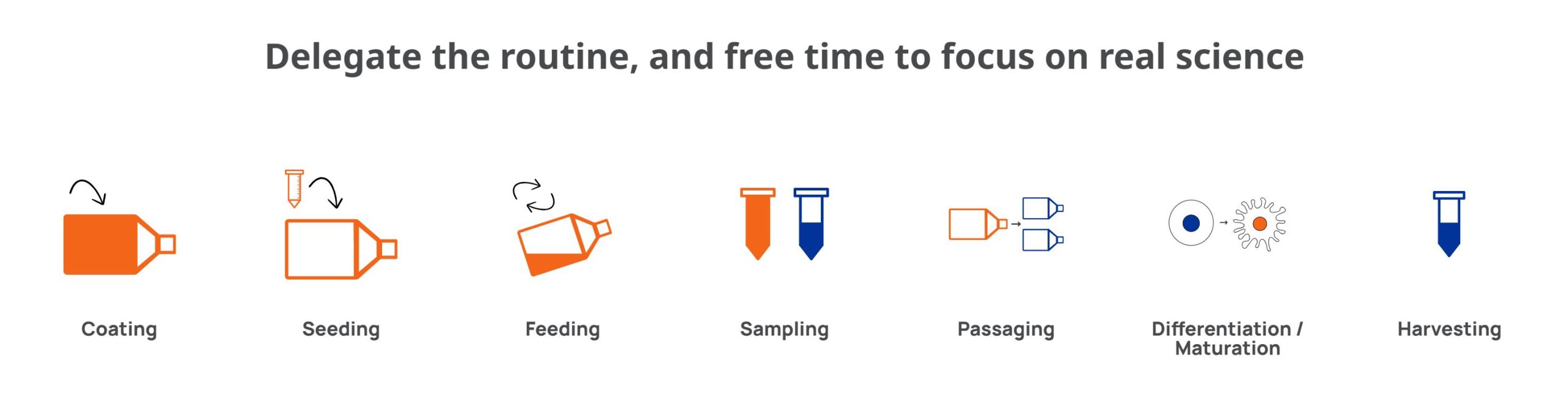
What happens if I need to scale up from 24-well plates to T225 flasks mid-experiment?
This is exactly the type of workflow Nestor excels at. You can start with optimization in 24-well plates, identify your best conditions, then scale up through 6-well plates and into T75, T175, or T225 flasks—all using the same automated system. This eliminates the variability that comes from switching between manual and automated handling at different experimental scales. The consistent liquid handling across formats ensures that what works in your 24-well optimization will translate reliably to your production-scale flasks.
How does Nestor handle contamination prevention across different formats?
Nestor maintains sterility through enclosed automated handling that minimizes exposure to the environment. The system uses sterile, disposable tips for liquid handling, and all vessel manipulation occurs within a controlled environment. Between different vessel types, the system follows programmed decontamination protocols.
This automated approach actually reduces the risk of contamination compared to manual handling, where opening the culture vessels each time creates a potential contamination point.
Can I automate the culture of my specific cell line or organoid model?
Nestor is designed for adherent cells, stem cells (including iPSCs and ESCs), primary cells, and 3D organoid cultures. The system’s programmable protocols allow you to customize pipetting speed, mixing intensity, aspiration height, and incubation times to match your specific cell type’s requirements. Whether you’re working with delicate neural organoids or robust fibroblasts, you can optimize the protocol for your application.